
The 1990s
10 HYPES — 1990
10 hypes that took over America in 1990.
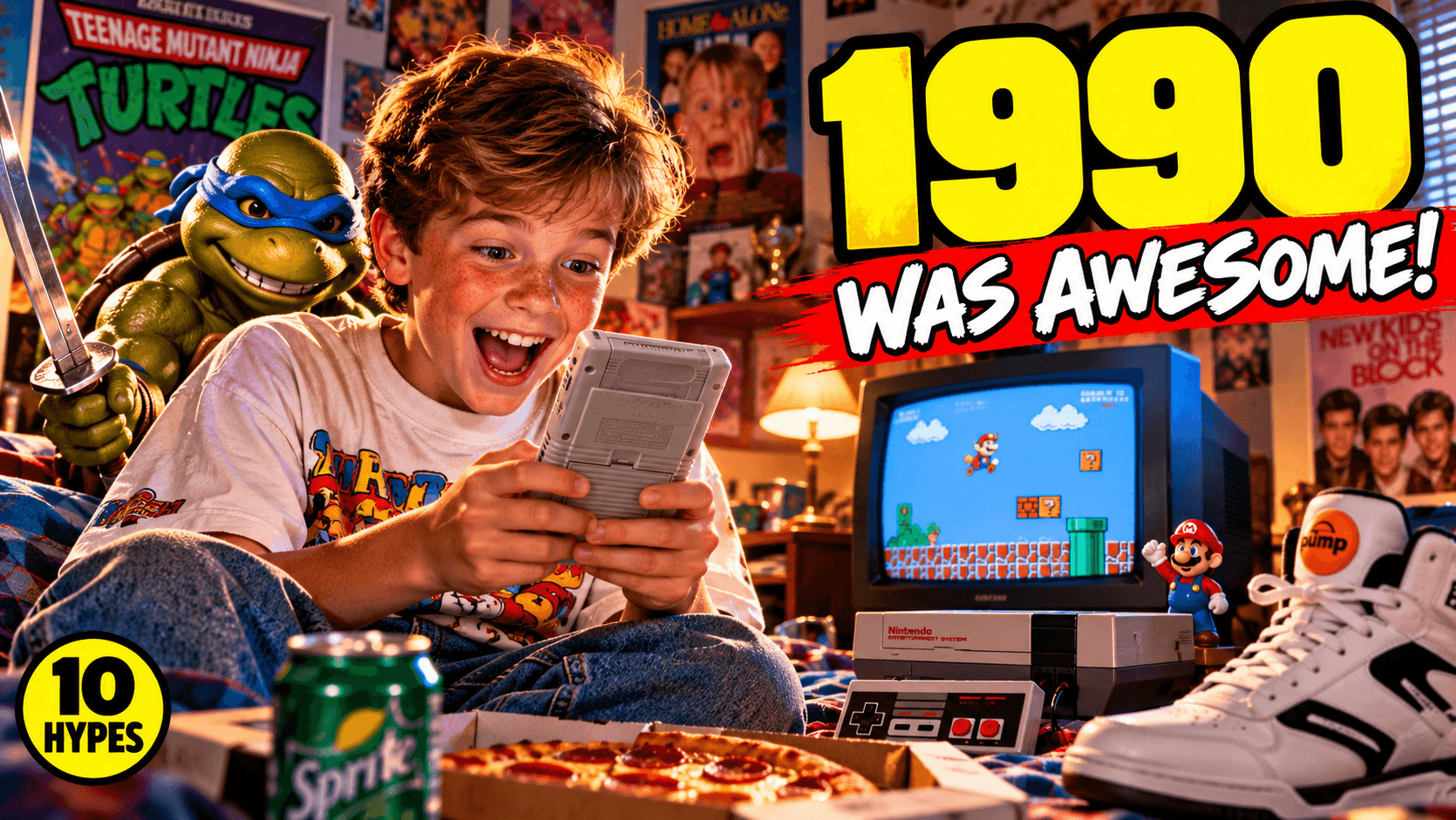
From Bart Simpson shirts and pump-up sneakers to portable Tetris and four pizza-loving turtles, these were the television shows, toys, games, movies, and music crazes that seemed to follow Americans everywhere in 1990.
#10
tv
The Fresh Prince of Bel-Air
In 1990, Bart Simpson could get your T-shirt banned at school. Sneakers came with a button you could pump. And one of the year’s biggest movie stars was a kid who turned his own house into a booby trap. The eighties had not disappeared, but entertainment was escaping its original screens. Cartoons became clothing, songs became dances, and video games could follow you out of the living room. These are the ten hypes that seemed to turn up everywhere. Will Smith arrived in Bel-Air with bright clothes, quick confidence, and no intention of quietly blending into his wealthy relatives’ world. The Fresh Prince of Bel-Air premiered on NBC on September 10, 1990, placing Smith’s established rap persona at the center of a network sitcom. The premise was wonderfully efficient: put Will and Uncle Phil in the same room, wait a moment, and somebody would probably disagree. In 1990, the show felt new—a comedy led by a rapper who did not need to hide his personality to become its star.
1990#9
fashion
Sneaker Culture and the Reebok Pump
Reebok put a tiny basketball on the tongue of a sneaker. Naturally, everybody wanted to press it. Pushing the button moved air into a bladder inside the shoe, allowing the wearer to adjust its fit. At about $170 when unveiled in late 1989, the original Pump was hardly cheap. But the design carried its own demonstration wherever it went. Sneakers were no longer just equipment; they could show taste, loyalty, and how persuasive a teenager had been with their parents.
1990#8
culture
WWF and Wrestling Buddies
The World Wrestling Federation already had heroes recognizable from across a room: Hulk Hogan in yellow, the Ultimate Warrior in face paint, and Randy Savage turning every interview into an event. In 1990, the toy aisle made those personalities portable. Hasbro offered action figures, while Tonka’s soft, oversized Wrestling Buddies gave children opponents they could actually grapple with. A Wrestling Buddy never complained about losing, demanded a rematch, or told a parent who started it.
1990#7
games
Game Boy and Tetris
The emergency was always the same: you needed the long block. Tetris made arranging shapes feel urgent, and Nintendo’s Game Boy allowed that urgency to follow players into cars, waiting rooms, and anywhere else a few spare minutes appeared. The gray handheld and its monochrome screen were not flashy, but Tetris did not need much scenery. Its rules took seconds to understand, while the gaps, towers, and increasingly desperate mistakes could keep someone occupied far longer. By April 1990, Nintendo reported more than 2.5 million copies of Tetris sold across its home-console and Game Boy versions.
1990#6
music
Hammer, Vanilla Ice, and Rap’s Pop Breakthrough
MC Hammer’s Please Hammer Don’t Hurt ’Em spent 21 weeks at number one on Billboard’s album chart, though not in one uninterrupted stretch. The dancing, loose-fitting pants, and opening of U Can’t Touch This were instantly recognizable—even though the single itself peaked at number eight on the Hot 100. Vanilla Ice joined the rush when Ice Ice Baby reached number one in November and To the Extreme topped the album chart. Rap had already developed over many years through varied performers, regions, and messages. What changed in 1990 was the enormous pop audience reached by particular crossover acts.
1990#5
music
New Kids on the Block
A New Kids on the Block fan could buy the record, hang a poster, wear a shirt, attend a concert, and place a favorite member on a shelf. Hasbro’s fashion dolls sold one million units in their first four weeks, according to an October 1990 report. Some buyers were as old as 15, suggesting these were not simply toys. They were physical souvenirs of a pop obsession—famous faces that remained in sight after the cassette ended and the television was switched off.
1990#4
movies
Home Alone
For a while, Kevin McCallister gets exactly what he wants. His family disappears, the house is his, and nobody can object to his dinner. Then two burglars become interested in the property. Home Alone opened on November 16, 1990, and turned staircases, doorknobs, and paint cans into parts of an elaborate defense plan. It led the domestic weekend box office from its opening through the end of the year and eventually held the top spot for 12 consecutive weekends. Its original domestic theatrical run earned about $286 million. The traps supplied the spectacle, but Kevin’s discovery that independence was lonelier and more complicated than expected gave the movie its heart.
1990#3
tv
Bart Simpson
Bart Simpson could cause trouble at school without attending. All he needed was a T-shirt. After The Simpsons became a weekly series at the end of 1989, Bart’s face and attitude spread across merchandise in 1990. Reports emerged of schools objecting to shirts that celebrated underachieving. Children saw a joke; some adults saw a challenge to the lesson they were trying to teach. A cartoon character had stepped off the screen and into arguments about dress codes, shopping, and copyright.
1990#2
games
Super Mario Bros. 3
Before many American players could buy Super Mario Bros. 3, they saw it featured in the 1989 movie The Wizard. When the game reached the United States in February 1990, Mario returned with flight, ability-changing suits, connected maps, hidden secrets, and the coveted warp whistles. Magazines, strategy guides, and schoolyard conversations helped those secrets travel. One player knew where an extra life was hidden; another insisted there was a route everyone else had missed. A later report quoted an analyst estimating $400 million in 1990 revenue for the game, though that was not a verified Nintendo year-end total.
1990#1
toys
Teenage Mutant Ninja Turtles
In 1990, a child could watch the Teenage Mutant Ninja Turtles at home, choose a favorite at the toy store, see them at the movies, and play as one beside friends at an arcade machine. The four heroes were everywhere—and they lived in a sewer. The live-action movie opened on March 30 and eventually earned about $135 million in the United States and Canada. But the film was only one doorway into the craze. The cartoon supplied personalities, the arcade game encouraged friends to fight side by side, and the toys moved the adventure onto bedroom floors. That reach earns the Turtles the number-one spot. Each format offered a different way into the same obsession. Turn off the television and the characters did not disappear; the next adventure was probably already waiting nearby.
1990