
Hype Stories · culture
Sky Dancers: The Flying Dolls Nobody Could Control
Sky Dancers turned a pull-string launcher and a spinning fairy doll into a major 1990s toy hit. The unpredictable flight made them exciting—and ultimately led to a recall of approximately 8.9 million dolls.
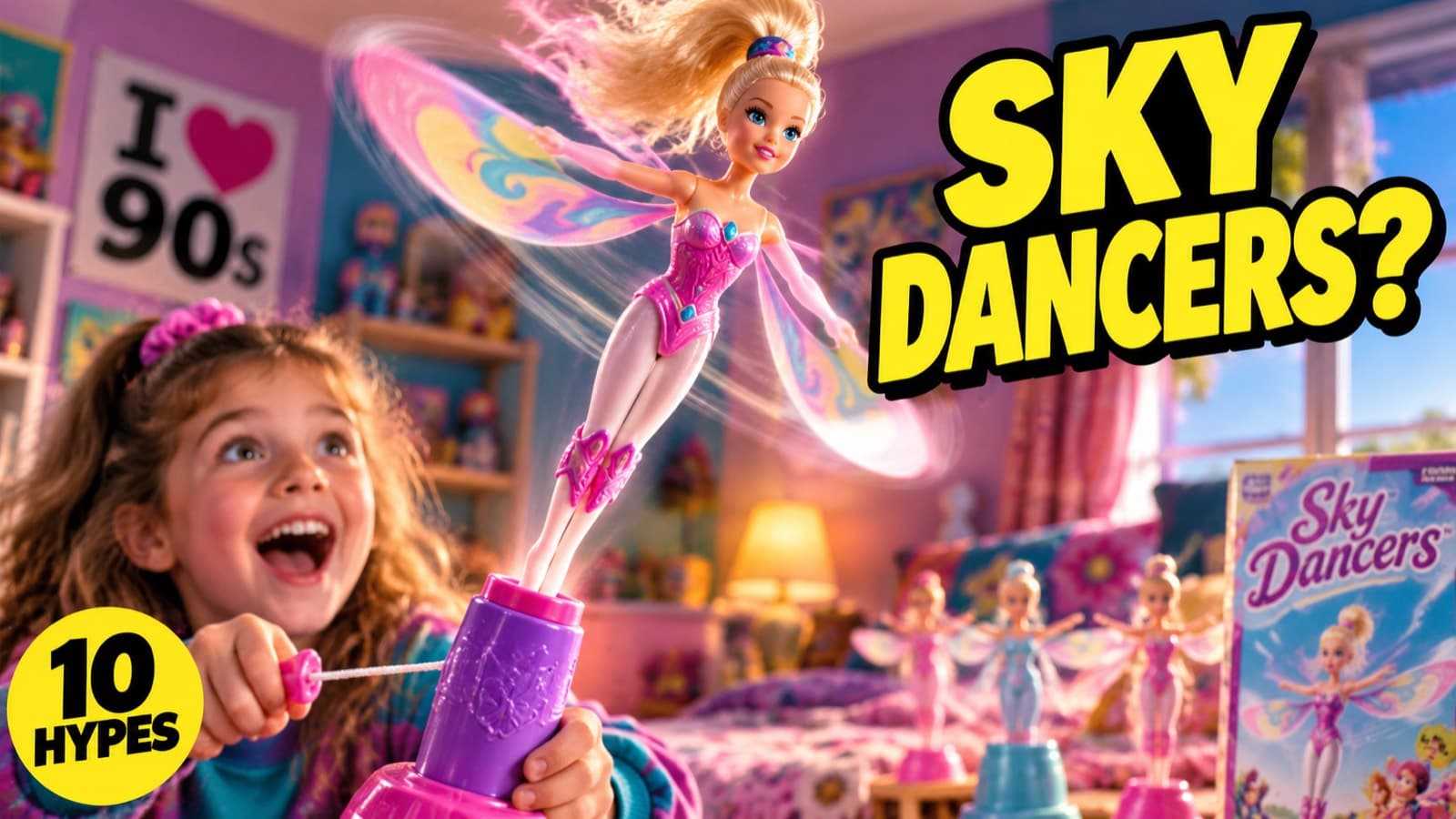
A Doll That Could Fly
Most dolls just sat there. Sky Dancers didn't.
Introduced by Galoob in 1994, these flying fairy dolls went feet-first into plastic launchers. Pull the cord and the doll shot upward, spinning through the air on stiff, wing-covered arms. No batteries. No motor. Just a pull-string and physics.
Sky Dancers worked because they combined two kinds of play that rarely met. Launching toys usually meant rockets and airplanes. Dolls belonged to a different category. Galoob put them together, and kids were ready for it.
By February 1995, Galoob said it had taken orders for one million Sky Dancers since January. The company raised its sales forecast from around $25 million to $40 million, while company history records put 1995 sales at more than $70 million. By April, Sky Dancer was reported as the No. 1-selling girls' toy in America.
The line expanded with new characters, colors and launchers shaped like flowers, dolphins, moons, ponies, suns and rainbows. There were handheld and tabletop versions, smaller dolls, a television series and other products. One strange toy had become a brand.
The Thrill of Not Knowing
The appeal was simple: Sky Dancers moved. Each pull produced the same satisfying sequence—the launch, the spin and the wait to see where the doll came down.
There was no steering, remote control or way to guide the doll after launch. That uncertainty made every flight a small experiment. How high would she go? Where would she land? Could you catch her and launch her again?
The unpredictable flight kept the toy interesting. It also created its biggest problem.
When the Flying Became the Problem
On June 27, 2000, the Consumer Product Safety Commission and Galoob announced a nationwide recall of approximately 8.9 million Sky Dancers sold in the United States from November 1994 through June 2000.
The CPSC said the hard-plastic dolls could fly rapidly in unpredictable directions and strike children or adults. Galoob had received 170 reports of people being struck and 150 reports of injuries, including scratched corneas, temporary blindness, broken teeth, a mild concussion, a broken rib and facial lacerations requiring stitches.
The recall exposed a problem that could not be separated from the toy's appeal. The flying mechanism was not a minor component that could simply be replaced. Flying was the whole point.
The CPSC later announced that Galoob had agreed to pay a $400,000 civil penalty over allegations that it failed to report defects and injuries in a timely manner. Galoob denied violating the Consumer Product Safety Act or any other law administered by the agency. Hasbro had acquired the company in 1998.
The Magic and the Problem
The original Sky Dancers were finished, but the idea returned in 2005 with a redesigned flying doll. The challenge remained the same: make it safer without removing the reason anyone wanted it.
Sky Dancers still stand out because one unusual feature transformed an ordinary doll into a major 1990s hit. The sales were real. The excitement was real. The safety problems were real too.
Kids who played with them remember the launcher, the pull of the cord and the split second when nobody knew where the doll would land. That was the magic. And that was the problem.