
Hype Stories · tech
How AOL Took Over America
Before smartphones. Before social media. Before broadband. There was AOL — and the free trial discs that showed up in mailboxes, Blockbuster, and even frozen Omaha Steaks.
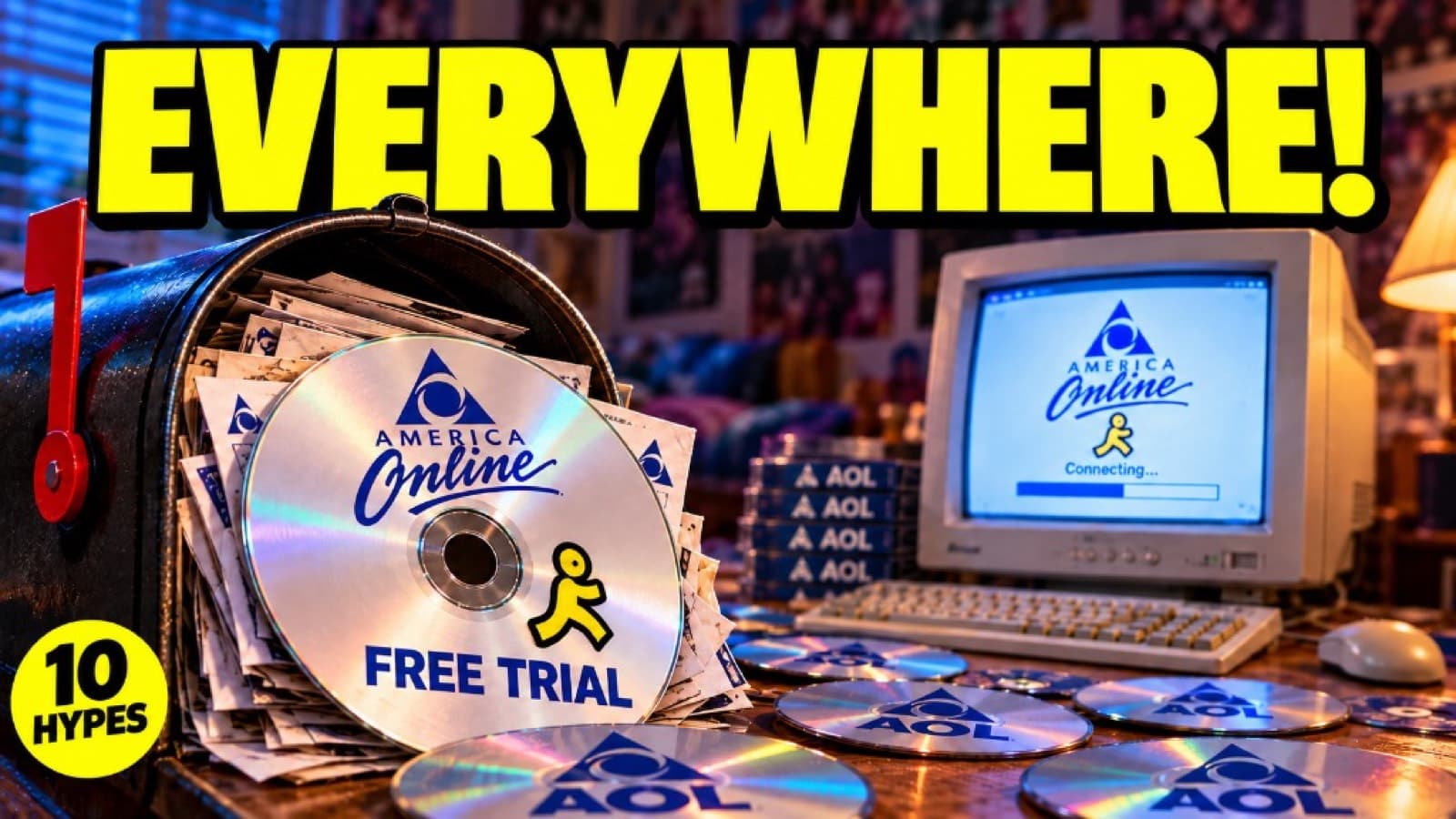
That wasn't desperation. That was a plan.
If you used a computer in the 1990s, there was a good chance AOL was trying to get into your house. The discs showed up in your mailbox. They were stuffed into magazines. They were sitting at Blockbuster. And somehow, you could even find them inside packages of frozen Omaha Steaks.
In the early 1990s, most Americans had little experience with the internet. You couldn't really explain it to someone who had never used it. So AOL stopped trying to explain it. It gave people a way to try it.
Carpet bombing
In 1993, AOL marketing executive Jan Brandt began pushing an aggressive free-trial campaign: skip the pitch, put the product in people's hands. One early mailing reportedly produced a response rate of more than ten percent. Then AOL scaled it — through Blockbuster, Barnes & Noble, banks, magazines, and those frozen steaks.
Brandt later described the strategy as “carpet bombing.” AOL spent hundreds of millions of dollars on it. At the height of the campaign, she said AOL-branded discs represented half of all CDs produced worldwide. That figure is her account, not an independently measured statistic — but it tells you the scale she was describing.
You've got mail
At the end of 1993, AOL had around 300,000 subscribers. By early 1995 it had passed 1.5 million. By the end of that year, roughly 4.5 million — then 7 million, then 8 million. You plugged in a phone line, clicked connect, and the modem made that horrible collection of screeches that somehow meant you were going online.
Email. Chat rooms. News. People you knew, and people you'd never met. Then the phrase that became part of everyday life: You've got mail. AOL Instant Messenger launched in 1997. AOL wasn't just selling internet access. It was selling an experience people could understand.
Too many people online
On December 1, 1996, AOL introduced a $19.95 unlimited-use plan. Customers stopped watching the clock. Millions of people tried to get online at the same time. Busy signals became common. Some people couldn't get online at all.
That August, a technical failure had already knocked AOL offline for almost 19 hours — more than six million subscribers. The company spent about $350 million expanding network capacity. AOL had spent years trying to get people online. Now it was spending hundreds of millions trying to keep them there.
You got AOL
By November 1997, AOL had passed 10 million subscribers — one contemporary estimate put it at roughly half of U.S. households that were online. By 1999 it had passed 20 million, and by December of that year it was worth roughly $200 billion. In January 2000 came the planned merger with Time Warner, valued at $164 billion.
The discs weren't really the product. They were the invitation. You heard the modem. You waited. You connected. And then a voice told you: You've got mail. You didn't just get online. You got AOL.